


Here are the search results from the YouTubes with pages and pages of backing tracks, meaning tracks with no bass on them for us to play along with.
The styles vary from gospel to funk to blues to jazz so it is pretty good sampling of styles. And, lets face it, sometimes practicing bass without a band around sounds pretty empty. It makes practicing a lot more fun if you can hear what things sound like against chords and grooves.
And if you find one you like and want to keep it, check out http://keepvid.com/ (there are others like this too out there and plug-ins and browser extensions and stuff too). They will download any YouTube clip you want, and they have a little bookmarklet thingy that if you drag it to your browser bar, when you are on a YouTube page it figures out the video and downloads it for you. So you can harvest these things and play them on your 'puter whenever you want. Enjoy.
http://keepvid.com/
YouTube Bass Backing Track List
Showing posts with label play-along. Show all posts
Showing posts with label play-along. Show all posts
13.7.12
24.4.11
A Minor Funk Loop For Practice
The play-alongs have been very popular, so here is one that is nice and simple and will let you go ridiculoso all over A minor. (UPDATE: Now there are two. Both A min. What the hell. Why not.)
It's just that one chord, A minor with a gee-tar, a synth and drums, and it will loop until you can't take it anymore and make it stop. So drop it in your favorite loop-able audio player of choice and commence to A minor-ing.
Slap away over it or do some fingerstyle funk or do some one-chord-vamp soloing. Go nuts.
A minor, for the whole thing.
It's just that one chord, A minor with a gee-tar, a synth and drums, and it will loop until you can't take it anymore and make it stop. So drop it in your favorite loop-able audio player of choice and commence to A minor-ing.
Slap away over it or do some fingerstyle funk or do some one-chord-vamp soloing. Go nuts.
A minor, for the whole thing.
http://www.divshare.com/download/14665147-e04
http://www.divshare.com/download/14665981-b56

11.4.11
Speaking Of Play-Along Tracks...
Well, TrueFire, the online music instruction site, has about 200 different blues play-alongs for ya.
These range in tempo from 60 to 200 bpm and are in a variety of styles (chicago, texas, etc). Each one has an mp3 and a chart.
They have bass parts, but you can still solo over them.
Some are, eh, corny, but there are some decent ones up there for sure. If you are looking for some more free play-alongs there ya go.
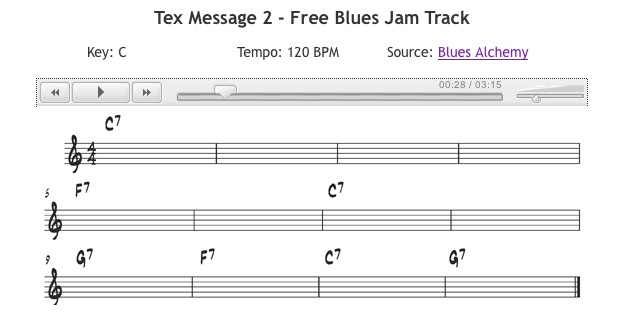
These range in tempo from 60 to 200 bpm and are in a variety of styles (chicago, texas, etc). Each one has an mp3 and a chart.
They have bass parts, but you can still solo over them.
Some are, eh, corny, but there are some decent ones up there for sure. If you are looking for some more free play-alongs there ya go.
http://truefire.com/jam-tracks/
10.4.11
Daily Licking 039: Minor Blues in C
Well, you greedy bastards sure like free stuff.
The ii-v play along has been surprisingly popular, so here is another very simple play-along track for you to pilfer.
This time it is a minor blues in C, with a couple of altered chords thrown in.
Follow the same drill as before, download the file and the chart, put the audio into a player that can do seamless looping (like Quicktime Player) and repeat ad infinitum and commence to shredding. There is no bass on this so you can solo or play a bass line along with the chords. Knock yourself out.
Enjoy.

The ii-v play along has been surprisingly popular, so here is another very simple play-along track for you to pilfer.
This time it is a minor blues in C, with a couple of altered chords thrown in.
Follow the same drill as before, download the file and the chart, put the audio into a player that can do seamless looping (like Quicktime Player) and repeat ad infinitum and commence to shredding. There is no bass on this so you can solo or play a bass line along with the chords. Knock yourself out.
Enjoy.
http://www.divshare.com/download/14533893-8dc
4.4.11
Daily Licking 038: JB Blues Progression
Here is a jazz-ed up blues progression that Jeff Berlin uses in his book on chord tones.
There are two versions of the audio, one at a tempo ridiculoso of 200 bpm, and one at a human tempo of 120 bpm.
Same drill as before, these are mp3s that play 5 times through the progression (so 60 measures total), but they are loopable so if you play them in any app that allows looping (and is any good at it) it will keep going and going.
I use Quicktime player, it works great, its free, and it's already on your machine if you have a Mac.

There are some extra juicy chords in this progression, some might look a little strange if you are used to playing the standard 3-chord I-IV-V blues. There are a bunch of extra dominant chords for the turnaround, a couple diminished chords sprinkled here and there, and even a fancy little thing called a tri-tone sub.
This tri-tone sub character shows up in measure 4, it is that E7, right after the Bb7 and right before the Eb7.

Here is the idea behind this crazy thing - the most important notes (other than the root) of any chord are the third and the seventh, because those are the notes that give away what type of chord it is, either major, minor, dominant, whatever. So those notes matter the most and the rest are somewhat secondary. There are a lot of piano players that don't even play the root sometimes, they just leave it out.
Now for the wild part: these two different chords, the Bb7 and the E7 have exactly the same third and seventh, they are just switched!. So that means if one were sneaky one could actually use one in place of the other if one wanted to make things sound a little more interesting. Check it out.
If we were going to follow the "rules" we would put a Bb (and lets just go ahead and make it a dominant since this is a blues shall we?) in front of the Eb, so we would get Bb7 to Eb7, or V to I. And that is how measure 4 starts, with a Bb7. So far so good. But then comes this E7. Huh?
Since you are a chord spelling master, you can peer into this mystery to see what notes make up both of these two chords in measure 4, the Bb7 and the E7.
Now instead of a measure of a single Bb7 chord, this progression does some ridiculoso extendo by adding that E7 after that Bb7 and now there are two different (but the same!) chords per measure and some additional choices are available for soloing instead of just have one chord per measure as a garden variety I-IV-V blues usually has.
So there ya go. The Tritone Substitution. This doesn't necessarily make the progression "better" or anything, it is just another way to add some interest to a blues.
There are two versions of the audio, one at a tempo ridiculoso of 200 bpm, and one at a human tempo of 120 bpm.
Same drill as before, these are mp3s that play 5 times through the progression (so 60 measures total), but they are loopable so if you play them in any app that allows looping (and is any good at it) it will keep going and going.
I use Quicktime player, it works great, its free, and it's already on your machine if you have a Mac.
Blues at 120 bpm
http://www.divshare.com/download/14491642-914
Blues at 200 bpm
http://www.divshare.com/download/14491643-cfd
There are some extra juicy chords in this progression, some might look a little strange if you are used to playing the standard 3-chord I-IV-V blues. There are a bunch of extra dominant chords for the turnaround, a couple diminished chords sprinkled here and there, and even a fancy little thing called a tri-tone sub.
This tri-tone sub character shows up in measure 4, it is that E7, right after the Bb7 and right before the Eb7.
Here is the idea behind this crazy thing - the most important notes (other than the root) of any chord are the third and the seventh, because those are the notes that give away what type of chord it is, either major, minor, dominant, whatever. So those notes matter the most and the rest are somewhat secondary. There are a lot of piano players that don't even play the root sometimes, they just leave it out.
Now for the wild part: these two different chords, the Bb7 and the E7 have exactly the same third and seventh, they are just switched!. So that means if one were sneaky one could actually use one in place of the other if one wanted to make things sound a little more interesting. Check it out.
If we were going to follow the "rules" we would put a Bb (and lets just go ahead and make it a dominant since this is a blues shall we?) in front of the Eb, so we would get Bb7 to Eb7, or V to I. And that is how measure 4 starts, with a Bb7. So far so good. But then comes this E7. Huh?
Since you are a chord spelling master, you can peer into this mystery to see what notes make up both of these two chords in measure 4, the Bb7 and the E7.
Notice anything? The important notes, the third and the seventh of both chords are THE SAME, just inverted. No way. Ya-huh. The third of one is the seventh of the other and vice versa. Oh, they try and deny it by going all enharmonic, but Ab is the same thing as G# remember, so when we pierce their little web of lies what we have is:Bb7
- Bb
- D
- F
- Ab
E7
- E
- G#
- B
- D
This is a tri-tone sub, you take a chord a tri-tone away from the chord you want to substitute for because it has the same juicy important notes (third and seventh) as the original chord. E is a tri-tone, or a flatted fifth away from Bb, but they both have a G# (or an Ab) and a D in them so they can behave very very similarly, and if you want, you can use one in place of another.Bb7
- Bb - root
- D - third
- F - fifth
- Ab (G#!) - seventh
E7
- E - root
- G#(Ab!) - third
- B - fifth
- D - seventh
Now instead of a measure of a single Bb7 chord, this progression does some ridiculoso extendo by adding that E7 after that Bb7 and now there are two different (but the same!) chords per measure and some additional choices are available for soloing instead of just have one chord per measure as a garden variety I-IV-V blues usually has.
So there ya go. The Tritone Substitution. This doesn't necessarily make the progression "better" or anything, it is just another way to add some interest to a blues.
3.4.11
Daily Licking 037: Playalong ii-v In All Keys
(fixed the link to the wrong mp3. Doh.)
Spent some time goofing around with GarageBand and the many minutes of hard work (not really), have resulted in a handy play along file that others may find some use for. Ya can't have too many ii-v's to practice. Use it to work up some of the ii-v licks posted previously, or your favorite lick from Pent-up House or just to practice soloing on, there are a million and one uses. Goes great on salads too.
The track is very very simple rhythmically, just whole notes, so you can really hear how any notes you play fit (or don't) against the chords. There is also no bass so you can add your own.
Here is a simple chart that shows the order of the progression. The mp3 is loopable so it will continuously repeat until you get the lick nailed. Click on the chart, save to disk, blah blah all that.

To loop the audio, just load the mp3 in Quicktime Player (free for mac and windows), and just select "Loop". Ta-da. Done. Then bust out your favorite ii-V-I lick and practice moving it through each key.
Enjoy. And if there are any other progressions y'all would like to see let me know, or if you would be interested in how to make your own, I could do a post on that as well. Ciao!
Spent some time goofing around with GarageBand and the many minutes of hard work (not really), have resulted in a handy play along file that others may find some use for. Ya can't have too many ii-v's to practice. Use it to work up some of the ii-v licks posted previously, or your favorite lick from Pent-up House or just to practice soloing on, there are a million and one uses. Goes great on salads too.
The track is very very simple rhythmically, just whole notes, so you can really hear how any notes you play fit (or don't) against the chords. There is also no bass so you can add your own.
Here is a simple chart that shows the order of the progression. The mp3 is loopable so it will continuously repeat until you get the lick nailed. Click on the chart, save to disk, blah blah all that.

To loop the audio, just load the mp3 in Quicktime Player (free for mac and windows), and just select "Loop". Ta-da. Done. Then bust out your favorite ii-V-I lick and practice moving it through each key.
http://www.divshare.com/download/14480543-5e1Some other things to do that are fun:
- Play just the third of each chord as a whole note. Record yourself so you can hear what that sounds like. Then do the 5th, 7th, etc to hear what each note sounds like against each chord.
- Run the arpeggio of each chord up and down.
- Play other arpeggios against the chord, for instance on Dmin, try a F maj, or an Amin arpeggio, on the G7 try a Bmin7b5 and go up to the ninth. HA! Tricked ya, that is just the G7 starting on the third! But check it out, play around with stuff like that.
- Start a scale on the third of each chord and go up in 8th notes. Try different scales (appropriate ones for each chord type). Where does the end of the scale leave you relative to the next chord? A nice juicy note?
- Play different pentatonics against each chord, on Dmin7 try Amin, Emin, and even, wait for it, Bmin.
- And of course, practice walking lines over the progressions. This is the most common progression there is in a lot of improvised music, so you can't ever go wrong trying different ways to connect these chords.
Enjoy. And if there are any other progressions y'all would like to see let me know, or if you would be interested in how to make your own, I could do a post on that as well. Ciao!
Subscribe to:
Posts (Atom)