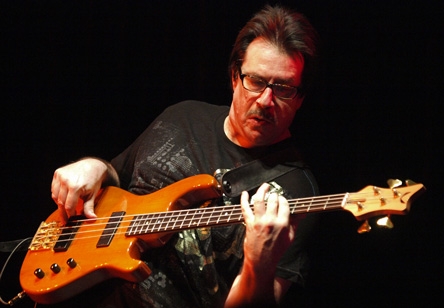
Showing posts with label Jeff Berlin. Show all posts

14.7.11

Traidpaloozza Number 2: Approach Tones

Okay. So you think "triads are easy". They are too simple. They are boring. They are old school they are not where it's at. Man.

Well, first of all, yes they are too cool. And secondly, if you really want to add something new to your triads, one of the most common ways to spice them up is to start adding approach tones to them.

These approach tones are tones that approach each note in the triad, ergo, the name.

Exactly where this approach note comes approaching from is where all the fun begins. You can approach the chord tones from a note above each chord tone, or a note below each chord tone, or a note above and a note below, or two notes below and then one note above or...you get the idea.

Here is how it goes: first we need a regular major triad so lets use G major, so G (root), B (third) and D (fifth).

bass lick tempo 120 4/4 | G g4 b4 d4 r4 |

Now lets add an approach note from below each chord tone so, a Gb/F# in front of the G, a Bb in front of the B, and a C# in front of the D

bass lick tempo 120 4/4 | G f#-8 g bb b c# d f# g |

Sounds more zesty huh? Thats a spicy meat-a-ball huh? But it gets better. As diligent readers know, there a musical concept of strong and weak beats that has been discussed here before. Having the notes of a chord occur on these strong beats just sounds better. It just does. This last example does NOT do this however, so while it sounds kinda cool, you can make it sound even better by just shifting things a little.

The strong beats are the down beats, so if you are counting "1 and 2 and 3 and 4 and", the strong beats would be the beats on the numbers, 1 2 3 4 and the "ands" are the weak beats. So if we do a little rhythmic shenanigans with these approach notes and push them back just one eighth note, look at what we get.

Approach From Below Rhythmically Arranged
bass lick tempo 120 4/4 f#-8 | G g8 bb8 b8 c#8 d8 f#8 g bb8 | G b8 c#8 d8 f#8 g2 |

Now the stronger notes, the chord tones themselves, are on the strong beats, the downbeats.

This is by far the better way to phrase with approach notes. Approach notes are not usually chord tones, they set up the chord tones, so you want to shift the approaches back so that the chord tone itself gets the down beat and comes down on one of those strong 1 2 3 4 beats.

Here is another set of approaches, the opposite of the first one, this time we will come from a note above each chord tone. So for the same G major triad, an Ab in front of the G (root), a C natural in front of the B (third), and an Eb in front of the D (fifth).

Approach From Above Rhythmically Arranged
bass lick tempo 120 4/4 ab8 | G g8 c8 b8 eb8 d8 ab+8 g8 c8 | b8 eb8 d8 ab+8 g2

But hold on, you say. There is no freaking Ab note in G Major! Those approach notes are not even in the key or the scale or the chord or anything, you can't just go adding notes like that willy nilly helter skelter hodge podge willy skelter!

Uhhhhh, why not?

Actually, you totally can. When you are embellishing a chord like this, it's okay that these approach notes are not in the key or the scale or don't seem related to the chord you are playing except that they are right next to them.

Its like this....say you have a big 4 pound steak, and you put some parsley on it, it doesn't make the steak taste like parsley. It still tastes like steak. You might get a molecule of parsley taste in there somewhere but your brain doesn't think you ate a fork full of salad all of a sudden. It still thinks "yum, dead cow parts". Well, triads are like a big fat fillet mignon cooked in garlic butter. You are gonna taste that meaty buttery garlicy cow no matter what, even if you put some fru-fru little green thing on top of a little part of it. That steak flavor still cuts through and is what you taste the most of, no problem.

That's what triads are like, they are grass fed medium well beef covered in garlic butter. Musically speaking. Even with an extra note in there, you still get the full meaty triad taste. Especially if you shift the approach notes so that the chord tones come in on the downbeats you can add all kinds of approach notes and still get the triad-y-ness of the chord you are playing.

Let's try it with two approach notes, and also get even more rhythmically crafty and make the approach notes 16th notes but keep the triads tones themselves as 8th notes.

Approach From Above & Below Rhythmically Arranged

bass lick tempo 120 4/4 ab16 f#16 | G g8 c16 bb16 b8 eb16 c#16 d8 ab+16 f#16 g8 c16 bb16 | b8 eb16 c#16 d8 ab+16 f#16 g2

Now reverse this pattern so that instead of above below, it is below above

Approach From Below & Above Rhythmically Arranged
bass lick tempo 120 4/4 f#-16 ab16 | G g8 bb16 c16 b8 c#16 eb16 d8 ab+16 f#16 g8 bb16 c16 | b8 c#16 eb16 d8 f#16 ab16 g2

There are other ways to vary the rhythms and the combinations of approach tones is endless as well. And you don't have to play the triads in R - 3 - 5 order either, try them in all the other combinations as well, but with the approach tones in front of each chord tone.

You get the idea, it can go on and on and on. For more info on this concept check out Gary Campbell, Hal Galper, Jeff Berlin, and every saxophone book ever written.

Of course this isn't just for soloing either, not so much for walking lines, but for sure on rock/pop/r & B lines you can use this all the time. Keep the approach notes shorter and on the weak beats for best results.

Try the approach notes here on major chords as well as minor chords and even the diminished and augmented. You will probably hear a few familiar licks in there from just these basic examples.

4.4.11

Daily Licking 038: JB Blues Progression

Here is a jazz-ed up blues progression that Jeff Berlin uses in his book on chord tones.

There are two versions of the audio, one at a tempo ridiculoso of 200 bpm, and one at a human tempo of 120 bpm.

Same drill as before, these are mp3s that play 5 times through the progression (so 60 measures total), but they are loopable so if you play them in any app that allows looping (and is any good at it) it will keep going and going.

I use Quicktime player, it works great, its free, and it's already on your machine if you have a Mac.

JB Blues SMALL.jpg


Blues at 120 bpm


http://www.divshare.com/download/14491642-914
Blues at 200 bpm


http://www.divshare.com/download/14491643-cfd

There are some extra juicy chords in this progression, some might look a little strange if you are used to playing the standard 3-chord I-IV-V blues. There are a bunch of extra dominant chords for the turnaround, a couple diminished chords sprinkled here and there, and even a fancy little thing called a tri-tone sub.

This tri-tone sub character shows up in measure 4, it is that E7, right after the Bb7 and right before the Eb7.
Picture 3.jpg

Here is the idea behind this crazy thing - the most important notes (other than the root) of any chord are the third and the seventh, because those are the notes that give away what type of chord it is, either major, minor, dominant, whatever. So those notes matter the most and the rest are somewhat secondary. There are a lot of piano players that don't even play the root sometimes, they just leave it out.

Now for the wild part: these two different chords, the Bb7 and the E7 have exactly the same third and seventh, they are just switched!. So that means if one were sneaky one could actually use one in place of the other if one wanted to make things sound a little more interesting. Check it out.

If we were going to follow the "rules" we would put a Bb (and lets just go ahead and make it a dominant since this is a blues shall we?) in front of the Eb, so we would get Bb7 to Eb7, or V to I. And that is how measure 4 starts, with a Bb7. So far so good. But then comes this E7. Huh?

Since you are a chord spelling master, you can peer into this mystery to see what notes make up both of these two chords in measure 4, the Bb7 and the E7.

Bb7

  1. Bb
  2. D
  3. F
  4. Ab

E7

  1. E
  2. G#
  3. B
  4. D
Notice anything? The important notes, the third and the seventh of both chords are THE SAME, just inverted. No way. Ya-huh. The third of one is the seventh of the other and vice versa. Oh, they try and deny it by going all enharmonic, but Ab is the same thing as G# remember, so when we pierce their little web of lies what we have is:

Bb7

  1. Bb - root
  2. D - third
  3. F - fifth
  4. Ab (G#!) - seventh

E7

  1. E - root
  2. G#(Ab!) - third
  3. B - fifth
  4. D - seventh
This is a tri-tone sub, you take a chord a tri-tone away from the chord you want to substitute for because it has the same juicy important notes (third and seventh) as the original chord. E is a tri-tone, or a flatted fifth away from Bb, but they both have a G# (or an Ab) and a D in them so they can behave very very similarly, and if you want, you can use one in place of another.

Now instead of a measure of a single Bb7 chord, this progression does some ridiculoso extendo by adding that E7 after that Bb7 and now there are two different (but the same!) chords per measure and some additional choices are available for soloing instead of just have one chord per measure as a garden variety I-IV-V blues usually has.

So there ya go. The Tritone Substitution. This doesn't necessarily make the progression "better" or anything, it is just another way to add some interest to a blues.

30.3.11

More of Jeff Berlin's Valse Nobles

Here are some additional resources for getting Jeff Berlin's Valse Nobles et Sentimentales together. Well, maybe not together but at least playable.

The full thing is here - http://bassoridiculoso.blogspot.com/2011/03/daily-licking-036-jeff-berlin-part-on.html, however that is only a pdf. The reason is because when I started figuring it out, well, lets just say there was some initial confusion in the rhythmic interpretation department of the thing and someone was under the mistaken impression there was more than one time signature involved. And it does not appear as though that is the case.

So, now you can hear just the bass part of the A section (via the always excellent bopland.org) and maybe get a handle on what the hell is going on.

There are two versions, one at Berlin-tempo-ridiculoso and one at a much more slow pace, around 60 bpm.

Then there are just the triplet licks broken out as well. They are not a paralyzingly frightening when they get slowed down and you can hear them by themselves a few times. And by few I mean about 700 or so.
Valse Nobles @ 200 bpm
bass lick swing 0 3/4 tempo 200 | Dbmaj db4. ab+8 f+4~| f8 e8 bb+4. f8 |Bb7 bb--4. ab+8 d4~| d8 b8 g+4. bb-8 | Eb eb-4. eb+8 b+4~ | b8 bb-8 f+4. g-8 | Dbmaj ab4 [d-8 ab+ c] [f ab c-] |[f d ab] [c f d] [ab c f] |db-4. ab+8 f+4~ | f8 e8 bb+4. f8 |bb--4. ab+8 d4~ | d8 b8 g+4. bb-8 |eb-4. eb+8 (g4~ b~) | (g8 b) bb-8 db+4. g--8 | c4 [eb8 e8 g-] [c eb gb] |c2 r4 |

Valse Nobles @ 60 bpm
bass lick swing 0 3/4 tempo 60 | Dbmaj db4. ab+8 f+4~| f8 e8 bb+4. f8 |Bb7 bb--4. ab+8 d4~| d8 b8 g+4. bb-8 | Eb eb-4. eb+8 b+4~ | b8 bb-8 f+4. g-8 | Dbmaj ab4 [d-8 ab+ c] [f ab c-] |[f d ab] [c f d] [ab c f] |db-4. ab+8 f+4~ | f8 e8 bb+4. f8 |bb--4. ab+8 d4~ | d8 b8 g+4. bb-8 |eb-4. eb+8 (g4~ b~) | (g8 b) bb-8 db+4. g--8 | c4 [eb8 e8 g-] [c eb gb] |c2 r4 |

First Triplet Catastrophe 60 bpm
bass lick swing 0 3/4 tempo 60 | Dbmaj ab+4 [d-8 ab+ c] [f ab c-] | [f d ab] [c f d] [ab c f] | r2 r4 | r4 r2 | r4 r2 |

Second Triplet Catastrophe 60 bpm
bass lick swing 0 3/4 tempo 60 | Dbmaj c+4 [eb8 e8 g-] [c eb gb] | c2 r4 | r2 r4 | r2 r4 |

25.3.11

Daily Licking 036: Jeff Berlin's Part on Valse Nobles et Sentimentales

jeffberlina.jpg

And now for something completely, completely different.

Classical music for the electric bass? What? Sacrilege! Blasphemy! An amplified fretted instrument? Why, it just isn't done, my good man!

Oh yea?

Electric bass players have been playing classical stuff, oh, excuse me, *ahem*, etudes for quite a while. Various solo cello parts, Bach inventions and string quartet parts have all been adapted by those with profundo ridiculoso to be playable on bass. Jaco and John Pattituci have done it, not to mention countless other really great players that no one knows up on the YouTube.

Enter Mr. Jeff Berlin. He is easily in the top 5 of those who learned their way around the monkey wrench of an instrument that is the electric bass, and Mr. Berlin is no stranger to music written by dead foreigners from Euro-pia. He busted out an arrangement of a Bach prelude on one of his previous records, and even doubled-down on the sacrilege by putting a solo section smack dab in the middle of it. AND it had an electric guitar solo too.

On his most recent album, "Higher Standards" Mr. Berlin sets his musical wayback machine to only the beginning of the 20th century this time and plays a movement from a collection of waltzes "Valses nobles et sentimentales" by Maurice Ravel. Mr. Berlin plays the role of the bass player in a duet with Richard Drexler on piano, and himself on the electrified, fretified bass guitar.

This piece is less baroque and much more lush and romantic compared to his previous Bach renditions and the movement he plays, Number IV, is both pretty and delicate yet also ominous and spooky all at the same time.

Here are some versions of it on piano, one even by Maurice Ravel himself, who was recorded using the state of the art (in 1913) new-fangled technology of the player piano.


Here are some recorded versions of it with just piano. It is not the entire suite, only Number IV that you want.

http://www.pianosociety.com/cms/index.php?section=175
The Bass Part
The good news: This is the easiest thing to play on his latest record.

The bad news: This is the easiest thing to play on his latest record.

And it is not easy.

Here are a few places you can hear snippets of Jeff's version online:

http://www.cdbaby.com/cd/JeffBerlin1

http://www.emusic.com/album/Jeff-Berlin-High-Standards-MP3-Download/11971122.html

This is one that is going to take repeated listening and lots of slow, and I do mean  s l o w   practicing to get it together.

Even though this is for bass, it has some serious finger twisters in it, fingerings that are not going to feel very familiar at all. This ain't "Mustang Sally". In some measures it changes between e flats and e naturals, b flats, and b naturals and g flat and g naturals. When you work out the fingerings for this, prepare yourself for saying "You have got to be kidding me" a lot.

Rhythmically, they do it very rubato-y in places. But just when you think they are going to break tempo, they really don't, but it is very rolling and fluid. Don't play this like a sequencer part, it has to have some lilt in it and it has to breathe in certain places.

You can also see a full score version written out if you want at the ISLMP site. There is both an orchestral version and one for just piano as well.

http://imslp.org/wiki/File:Ravel_-_Valses_nobles_et_sentimentales.pdf

As far as I could tell, Mr. Berlin's part is a mixture of the left and right hand.

And if anyone finds any mystery notes, let me know. There may be a few in there, my fingers and eyes were blurring after a while. 

Good luck!