Showing posts with label blues. Show all posts

5.12.13

Ron Carter Playing "Blues in F" Analyzed Note-By-Note


Back again with another transcription. This time really meaty stuff for us bass player - a walking line in F Blues.

Know how to make all your tappers, slappers, hair-scrunchy users, 9-string-detuned-to-a-low-C-alto-contrabass players pipe down?

Tell them to walk over an F Blues for a couple of choruses. Yea, suddenly they have to fix some knobs on their amp or something....real quick.

But I kid, all that stuff is great, but most people want and need BASS playing underneath them, and you can't get more back to basics than playing a bass line over an F blues. People spend lives and careers doing this. I can't even imagine how many times people like Jerry Jemmott, Ray Brown, Paul Chambers, John Paul Jones, or any other well known bass player walked or played blues of some style. Probably represents years worth of their time spent playing. If you can't make a blues sound good.....keep practicing!

Here is Ron Carter's bass line from a play-along he did many moons ago. It was from an Abersold playalong of Charlie Parker tunes, but this was a blues in F.

The recording is on Spotify, along with many other Abersold and Hal Leonard play alongs. Not an advertisement for them, just was up there and found there are quite a few play alongs on Spotify. So there you go, hunt it down and listen to him play it. It is from Vol 6., "All Bird".

Ron Carter gets called "The Most Recorded Bassist Ever", and it would take 10 pages to list everyone he has played with, everyone from Miles Davis to rappers. Take a look at how a master plays over one of the foundational song forms.

Some questions one might ask oneself:

  1. What notes does he use?
  2. How rhythmically complex is the line?
  3. Does he play roots on specific beats?
  4. How does he handle chords that last two measures? Or chords that only last two beats?

All the notes are labeled with the relationship they have to that particular chord. So for instance if you see the note "C" on a "C7" it is the root, ("R"), but if you see a "C" on an "F7" it is "5" or on a "Bb7" it is a "9".

Check it out and steal some lines from the best!


13.7.12

YouTube Backing Tracks

Here are the search results from the YouTubes with pages and pages of backing tracks, meaning tracks with no bass on them for us to play along with.

The styles vary from gospel to funk to blues to jazz so it is pretty good sampling of styles. And, lets face it, sometimes practicing bass without a band around sounds pretty empty. It makes practicing a lot more fun if you can hear what things sound like against chords and grooves.

And if you find one you like and want to keep it, check out http://keepvid.com/ (there are others like this too out there and plug-ins and browser extensions and stuff too). They will download any YouTube clip you want, and they have a little bookmarklet thingy that if you drag it to your browser bar, when you are on a YouTube page it figures out the video and downloads it for you. So you can harvest these things and play them on your 'puter whenever you want. Enjoy.

http://keepvid.com/

YouTube Bass Backing Track List

24.5.11

Announcing "The Bergonzifying Transmogrifier" - A Basso Web App

Boy, are you gonna be glad you were not Raptured.

Behold.


Picture 1 copy.jpg


Presented for your approval and edification, the first web app from Casa De Ridiculoso, The Bergonzifying Transmogrifier. Perhaps the first of many, who knows.

By way of the following uncharacteristically informative summary you can learn what this thing is and what it is for.

11.4.11

Speaking Of Play-Along Tracks...

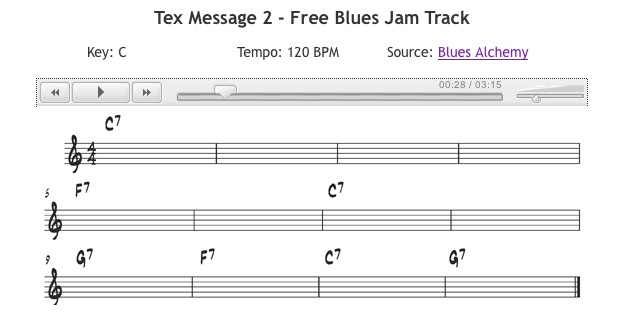
Well, TrueFire, the online music instruction site, has about 200 different blues play-alongs for ya.

These range in tempo from 60 to 200 bpm and are in a variety of styles (chicago, texas, etc). Each one has an mp3 and a chart.

They have bass parts, but you can still solo over them.

Some are, eh, corny, but there are some decent ones up there for sure. If you are looking for some more free play-alongs there ya go.

http://truefire.com/jam-tracks/

Picture 2.jpg

10.4.11

Daily Licking 039: Minor Blues in C

Well, you greedy bastards sure like free stuff.

The ii-v play along has been surprisingly popular, so here is another very simple play-along track for you to pilfer.

This time it is a minor blues in C, with a couple of altered chords thrown in.

Follow the same drill as before, download the file and the chart, put the audio into a player that can do seamless looping (like Quicktime Player) and repeat ad infinitum and commence to shredding. There is no bass on this so you can solo or play a bass line along with the chords. Knock yourself out.

Enjoy.


http://www.divshare.com/download/14533893-8dc

Small Minor Blues.jpg

4.4.11

Daily Licking 038: JB Blues Progression

Here is a jazz-ed up blues progression that Jeff Berlin uses in his book on chord tones.

There are two versions of the audio, one at a tempo ridiculoso of 200 bpm, and one at a human tempo of 120 bpm.

Same drill as before, these are mp3s that play 5 times through the progression (so 60 measures total), but they are loopable so if you play them in any app that allows looping (and is any good at it) it will keep going and going.

I use Quicktime player, it works great, its free, and it's already on your machine if you have a Mac.

JB Blues SMALL.jpg


Blues at 120 bpm


http://www.divshare.com/download/14491642-914
Blues at 200 bpm


http://www.divshare.com/download/14491643-cfd

There are some extra juicy chords in this progression, some might look a little strange if you are used to playing the standard 3-chord I-IV-V blues. There are a bunch of extra dominant chords for the turnaround, a couple diminished chords sprinkled here and there, and even a fancy little thing called a tri-tone sub.

This tri-tone sub character shows up in measure 4, it is that E7, right after the Bb7 and right before the Eb7.
Picture 3.jpg

Here is the idea behind this crazy thing - the most important notes (other than the root) of any chord are the third and the seventh, because those are the notes that give away what type of chord it is, either major, minor, dominant, whatever. So those notes matter the most and the rest are somewhat secondary. There are a lot of piano players that don't even play the root sometimes, they just leave it out.

Now for the wild part: these two different chords, the Bb7 and the E7 have exactly the same third and seventh, they are just switched!. So that means if one were sneaky one could actually use one in place of the other if one wanted to make things sound a little more interesting. Check it out.

If we were going to follow the "rules" we would put a Bb (and lets just go ahead and make it a dominant since this is a blues shall we?) in front of the Eb, so we would get Bb7 to Eb7, or V to I. And that is how measure 4 starts, with a Bb7. So far so good. But then comes this E7. Huh?

Since you are a chord spelling master, you can peer into this mystery to see what notes make up both of these two chords in measure 4, the Bb7 and the E7.

Bb7

  1. Bb
  2. D
  3. F
  4. Ab

E7

  1. E
  2. G#
  3. B
  4. D
Notice anything? The important notes, the third and the seventh of both chords are THE SAME, just inverted. No way. Ya-huh. The third of one is the seventh of the other and vice versa. Oh, they try and deny it by going all enharmonic, but Ab is the same thing as G# remember, so when we pierce their little web of lies what we have is:

Bb7

  1. Bb - root
  2. D - third
  3. F - fifth
  4. Ab (G#!) - seventh

E7

  1. E - root
  2. G#(Ab!) - third
  3. B - fifth
  4. D - seventh
This is a tri-tone sub, you take a chord a tri-tone away from the chord you want to substitute for because it has the same juicy important notes (third and seventh) as the original chord. E is a tri-tone, or a flatted fifth away from Bb, but they both have a G# (or an Ab) and a D in them so they can behave very very similarly, and if you want, you can use one in place of another.

Now instead of a measure of a single Bb7 chord, this progression does some ridiculoso extendo by adding that E7 after that Bb7 and now there are two different (but the same!) chords per measure and some additional choices are available for soloing instead of just have one chord per measure as a garden variety I-IV-V blues usually has.

So there ya go. The Tritone Substitution. This doesn't necessarily make the progression "better" or anything, it is just another way to add some interest to a blues.

12.3.11

Daily Licking 031: Bass Line for Chorus 5 & 6 of Mr. P.C.

Well, caught up with the tenor solo finally, both are all the way up to chorus number 6.

This bass line keeps getting more and more interesting, this guy is just as nuts as Coltrane. Let us examine these next 24 measures.

10.3.11

Daily Licking 030: Bass Line for Chorus 3 & 4 of Mr. P.C.

Two more choruses, (chori?) coming at you and guess what, this guy breaks the rules too.
To B natural
Some funny things start happening in these two choruses, and I don't mean funny ha-ha.

For one, a suspicious number of b naturals start showing up in the bass line. I think he is in cahoots with Mr. Coltrane. Up until this chorus, he would play B flats, but what do you think, do you think he and Coltrane got together beforehand and agreed to do this? Or do you think that now that he is three choruses in, and Mr. P.C. has heard Coltrane go all honey-badger bananas and spray B naturals everywhere, so him and his radar ears just said "Oh it's like that, huh? Okay, it's on!" and started throwing natural sevenths into the bass line as well. That is a bass player that is listening, right there.

6.3.11

Daily Licking 028: Bass Line For Head to Mr. P.C

A brief respite from the tenorisms of Mr. Coltrane for today.

Rather we shall take a look at what the songs name sake, Mr. Paul Chambers, is doing down there at over 200 bpm while Coltrane is busy abusing those poor chord tones.

So, below are the first two choruses of the bass line, the one played during the melody of Mr. P.C.

3.3.11

Daily Licking 027: Chorus 6 of Mr. P.C.

Its like he has an army of chord assassins and uses ninja fingers that shoot fire to create music that regular people will never be able to comprehend. Because they don't have tiger blood.

No, not that guy, oh please, that guy is a mere insignificant napping earthworm compared to the ridiculoso orignal, tiger-blooded, martian rock star, sick of pretending he is not special, musical genius F-18 that is - Coltrane.

Just wanted to clear that up once and for all.

And as exhibit A, let us delve into chorus number 6 from said maniac.

1.3.11

Daily Licking 026: Back to Coltrane - Chorus 5 of Mr. P.C

Okay, after having to resort to repeated listening of "Music Box Dancer" in order to offset the Coltrane that has been bored into my ear holes, it is now possible to resume with our next chorus of the merciless onslaught. Steel your loins. If you have them.
Flouting
He is not happy with just playing "wrong" notes all over the place, he is double-dog-daring someone to call him on it. He is saying, "hey, its not enough for you when I play the major seven huh, well how about if it is the very first note of an entire chorus, huh, now what you are gonna do? Huh? Oh you gonna do something now?".

27.2.11

Daily Licking 025: McCoy Tyner's Full Blues Chorus Solo Phrase

Okay, still not recovered to handle another 12 measures of Coltrane tonight, so instead...McCoy Tyner.

McCoy is one of the last living old timers, between him and Sonny Rollins, they represent some of the last living links back to the early days of bop all that jazz has been through since then. The list of people McCoy has played with is like a history book of jazz - Coltrane, Brecker, Jones, Garrison, Henderson, Dorham, Blakey ... the list has all of 'em. How many albums has he been on? 100? 500? A heck of a lot. He even had Derek Trucks play on his last album, so he is just about making music of any kind, even now in his 70's.

I have been listening to Inception, McCoy's debut album as a leader, every day since I found it. He plays so many cool things on each tune every time through there is something new and awesome lurking around in there.

Case in point - the song "Blues For Gwen". It's just a blues right, every jazz album has one. What's the big deal. Well, check out the entire chorus below which is basically one crazy long complete phrase ridiculoso that McCoy just kinda rattles off like it was nothing as the eighth chorus he takes (at about 2:03). .

McCoy playing it at tempo (about 225 ish)
McCoy Speed for Bass

bass lick 4/4 swing 70 tempo 230 | Bb7 ab+ f g ab g e f g | ab f gb ab f db eb f | eb c d eb d bb a g | db+ b~ b db (a b) gb ab a | Eb7 ab+ f g ab g eb d c | db f db4 eb8 d db4 | Bb7 r8 d f c+ a bb [d- f g] | f gb a gb f eb db b | Cmin7 gb+ b bb gb e bb+ a g | F7 f e eb g d c f eb | Bb7 d bb g f bb4 bb4 | Bb7 r1 |
McCoy Half-Speed
Half Speed For Bass
bass lick 4/4 swing 50 tempo 112 | Bb7 ab+ f g ab g e f g | ab f gb ab f db eb f | eb c d eb d bb a g | db+ b~ b db (a b) gb ab a | Eb7 ab+ f g ab g eb d c | db f db4 eb8 d db4 | Bb7 r8 d f c+ a bb [d- f g] | f gb a gb f eb db b | Cmin7 gb+ b bb gb e bb+ a g | F7 f e eb g d c f eb | Bb7 d bb g f bb4 bb4 | Bb7 r1 |


You bust out a phrase like this on your next solo and watch the props you get. Wow.

You think it is gonna end, but it doesnt end, it just keeps going and then at the end it just parks itself with a "how do you like them apples, huh?" finality to it. A whole chorus as one phrase takes some big ears.

Bravo!

Daily Licking 024: Chorus 4 Of Mr. P.C.

The merciless onslaught continues. I had the ominous feeling while doing this chorus that...he is just getting warmed up. Yikes.
OMG!OMG!OMG! He played a Bb on the C min!!!
Okay, well don't get as excited as I did, because he only plays it for half a beat, on the very last beat of a measure of the C min, before it goes to the F min, measures 4 to 5. He only resorts to playing the B flat instead of the B natural (which he already played 3 times in the 4 measures before that) so he can really set up the F minor. He anticipates the change by a half a beat and listen to how it sets up that F min.

24.2.11

Daily Licking 021: Chorus 3 of Mr. P.C for Bass

What will happen today? Will he play a Bb on the C minor? Will he force some crazy chord substitution over an F min chord that never did anything to anyone to warrant such treatment? Let us see what chord carnage Mr. Coltrane has in store for these poor unsuspecting next 12 measures of his minor blues, Mr. P.C.

23.2.11

Daily Licking 020: Chorus 2 Of John Coltrane's Mr. P.C. Solo.


Continuing from yesterday's episode...we left our hero, Mr. Coltrane rapidly, (and I do mean rapidly) approaching his second chorus...

And on this chorus he does some saxophone-isms that are somewhat simplified for bass here, some of the rhythms he plays are not exactly triplets, and they are not exactly 16ths either, they are of some kind of tenor-istic-phrasing-duration..so the rhythms represent as close as I could get. If anyone has any alternative suggestions, let me know.

30.12.10

"Whims of Chambers" Duet

This is the first thing I ever actually sat down and transcribed. It is the head to a blues by one of (if not THE) most recorded bass player in the history of bass playing, Paul Chambers.

This guy played on "So What" and "Giant Steps". Right there, he is legendary, but that only represents about .01% of the recordings he was on, it must seriously be in the thousands. And as far as who he played with, it is basically anyone you have heard of between the years of oh..say 1956 and 1965, it is ridiculoso! If you are into playing jazz, you gotta know this guy. It's like entire books could be written about him or something!

Here is the head in both bass clef and that other clef. You can give the other copy to a piano/guitar player and do a unison line like they did it on the recording. Horn players are gonna have to transpose it themselves if you have one those playing along. Take a listen to what it sounds like on the video at the end of the post also. Make it swing! Use your favorite blues changes for the soloing.