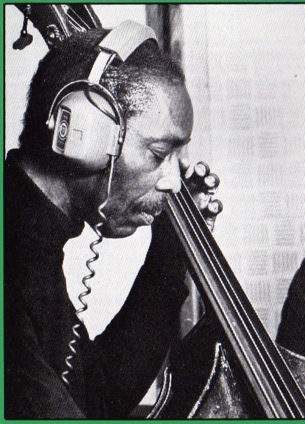
Here it is, served hot on a platter by Basso Ridiculoso, all of it - the famous Dorian intro vamp, the head played by
Mr. Miles Dewey Davis, then two choruses of your basic Cannonball Adderley alto-saxophonic melodious rhythmical genius, Miles soloing for two choruses, Hank Jones for only one chorus, Miles playing the head again, a rubato piano break down, and finally Hank Jones gets even and plays what is basically his second chorus on the way out for about 40 something bars over the same intro bass vamp.
The PDF below has what (I hope) are all the notes that
Mr. Sam Jones played during that entire thing on his upright bass.
This tune is taken from
a very famous album named "Somethin' Else" recorded by Cannonball Adderley for
Blue Note Records in
March of 1958 using all the guys mentioned above, plus Art Blakey on drums. If a person has any kind of jazz album collection, they own two jazz albums, "
Kind of Blue" and this album. It is early Cannonball at some of his best. This version of
Autumn Leaves is probably the most famous recorded version out there. If you accidently stand next to a piano for too long someone is going to ask you to play "
Autumn Leaves", so this is a tune you gotta know. Why not see what went down bass-wise on what many people think is the definitive version then, huh? This version of the song might also deserve to be famous as possibly the quietest Art Blakey has ever played sitting behind a drum set. The man did address those drums directly, didn't he. Boy howdy. But man, does he sound sweet and he and Sam Jones lock up and glide. This is how ya do a slowish, almost-but-not-really-ballad-tempo swing version of a tune.
And I gotta say, after doing this, my respect for Sam Jones has gone up
significantly. I am embarrassed to admit I kinda thought of him as the guy they got when they couldn't get Paul Chambers...but not anymore. Boy, was I epic-ly just wrong. The fact he played with Bill Evans should have been a bit of tip off. Mr. Jones has been promoted to a certified 4-Star
Generallisimo Ridiculoso with
oak leaf clusters and a little ribbon thing on it. His bass line is a thesis in harmonic and melodic bad-assery. Well played, sir!
This is one worth picking apart, examining and really looking at each measure. When you look at the bass line as a whole there is no doubt he was treating it as a melodic line and a spontaneous mini-composition.
Come then, let us probe the magnosity of this
grandissimo basso ridiculoso!
Noteable Notes
I think part of what makes it feels so composed is because of his use of
repetition. What, you say? He repeats himself? What's wrong, did he run out of ideas? You are supposed to never repeat yourself, right that's bad, right? No. I am gonna go with, no, he did it on purpose. Think about it, when you sing a song, is the melody completely different every time through? No. The melody has a cohesiveness and it gets that from repetition. It is how those songs get stuck in our head, because they have a hook, or a riff, or some melodic fragment that gets repeated over and over and over and over...
How Mr. Jones uses this effect is by playing the same phrase or recognizable arpeggio on a chord every time that specific chord comes around. The effect is that you really know where you are in the tune. Instead of having an endless stream of walking notes which are different in every bar every time through the tune, by returning to repeated phrases it really keeps the tune sounding like, well a tune, like one cohesive thing. Just like the melody of a tune, it repeats! Its subtle, but it really works. Check out a few examples:
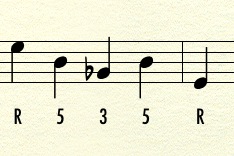
Almost every time the Eb Major comes around he plays this phrase:
on
that specific chord, Eb major, and almost exclusively on
that particular chord every time it comes around...pretty much. Now this is a pivotal chord because all the chords before this one have been moving in fourths and right after the Eb the tune jumps a TRITONE away to A min. A really big root motion change, so maybe he is offsetting that by giving your ears the same familiar line every time right before to set it up. Either way it totally works.
But
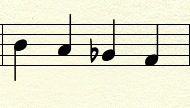
BY FAR, his favorite phrase of the tune is this one on G Min:
He plays that one a TON. It got so I started playing a game where I would just write that line in before the G Min came around, and then play those measures and see if I had to change any notes. Most of the time, I didn't have to, he plays it that often. But he keeps it for
just the G min chords as their own exclusive little unique VIP treatment. And pretty soon, it becomes its own predictable melody because it shows up at the same place every time, which is at the end of 8 measure phrases usually, so that familiarity and identifiable part really becomes a landmark and designates a part of the tune as just that, a part, not an endless stream of walking notes like I talked about up there. Its like punctuation, having a period at the end of sentence. Tricky, huh? That sneaky swinging maniac. And look at that -
Both his favorite phrases use almost exactly the same chord tones, just in a different inversion.
Another unifying thematic thing he does is start both of the trumpet choruses with almost exactly the same phrase, but he doesn't do that anywhere else, only to start those two choruses.
Range-wise, he doesn't go to any note higher than the "D" on his G string until about halfway through the first trumpet chorus. In all the 100-something measures before that you could play almost the entire bass line in the first position (the first 4 or 5 frets) there is just one or two C#'s or D's. And it still sounds
awesome. And there are maybe 20-25 notes total above that "C" in the entire bass line.
Some other things to notice:
Hardly any scale-wise movement in the bass line, he barely does any, only a couple of times. Stuff like this is pretty rare:
The bulk of the things he uses instead are:
Arpeggios/Chord Tones - playing combinations of just the chord tones of that measure. He does that a lot.
Passing tones/leading tones - a.k.a notes a half-step away from the next chord. He uses half-step approaches like crazy all over the place, down from the fifth, leading into the next chord, he does that one a lot.
Mr. Super Hip
He plays an E natural on the C minor chord a lot. During Cannonballs Solo chorus and the piano solo. That's kinda weird. He doesn't use it when he is leading into the F either, (although he does do that too) but as an arpeggio.
Also check out how sometimes he plays an E natural when he is walking up on a D chord, and sometimes he plays an Eb. b9's baby, the last dissonant frontier!
It depends on which part of the tune he is on, if that D is part of the key of G Maj (and so needs an E natural) or if it is part of Gmin, and needs it flatted. He picks the notes that give it away and uses it to play off the difference. Crafty.
But those particular parts were the most tricky and the ones that might get corrected by some wise guy, some of the notes were like an Eb-and-a-half, so maybe some I wrote as Eb's might be E naturals. Some are absolutely Eb's though.
Why this tune?
A couple of reasons, first, as I mentioned above it is pretty much the definitive version of this tune and a classic. Ya can't go wrong with that line up. And I couldn't find a complete (or free) version of this floating around on the net. Maybe it is out there, I am sure
many have transcribed this before I. Before me. Whatever. I couldn't find one.
Second,
the mix. On most Blue Note/Van Gelder recordings everyone was literally playing into two mics (for stereo, but some were even mono) but it wasn't like there were different tracks for each instrument, it was just two mics in a room, everyone was on the stereo track all smushed together. You needed less bass? He had to play softer. More piano, he had to play louder. No Pro Tools nonsense, just guys playing to tape.
But, on this recording, the bass is panned all the way to one side, so you can hear it a lot better than some recordings. I just panned to that side and was able to hear the bass as pretty much a 200-something measure solo. They gave the soloists their own mic, and the rhythm section must have got the other one completely to themselves.
I would suggest to play along with the tune that way, drop the track into Itunes, or
Transcribe! (which is what I used for this. Hands down the best transcription software around) and play with the stero/balance settings and listen to the bass and drums isolated. Then just read or play along. It will sound like the trumpet and alto are facing away from the mic and behind some baffles. Cannonball is still loud though, but the trumpet pretty much disappears.
Kill the Clams
Now, I checked this over and played along to it several times of course, but some mystery notes or clams may have snuck through. If you find one, let me know and you will get props here for taking me down a notch for writing down the wrong note. I don't have anything like a t-shirt or a gym bottle or goodies like that, but I will post your name for the world to see. Also, if you notice any interesting motifs or phrases post those for people to see also. There are
a lot more gems in this thing, there are rhythmic things he does during the head that set the stage for the notes he uses on those same chords throughout the entire tune. He really knew what he was doing.
When I went looking for a copy of this bass line on the internets (and didn't find one) I did find that
Rob Gourlay has this tune
in one of his transcription books, so if anyone has that, it would be interesting to check this version against his and see what is different. I, uh,
trust Mr. Gourlay's ears.

But really the process in and of itself is incredibly beneficial, even if a few clams made it through. I mean, it needs to be right and I will correct anything that is wrong, but the learning that you get during transcription is like taking musical steroids. So, what are you transcribing right now? Not "are you transcribing" but "what are you transcribing" because you need to start.
I gotta few others transcription ideas in the pipe, I may do the trumpet solo from this tune and put it in bass clef. If there is interest, I am happy to do a post on the transcribing process I use and maybe even a screen cast about it.
So there you have it. Please comment and let me know what you think. Also, this is for educational purposes, so don't repost it anywhere as your own or anything lame like that and of course the performance is all Mr. Sam Jones's. Please attribute and link back here to Basso Ridiculoso if you want to mention it online. Or I will come to your house and pee on your lawn.
Also, Basso Ridiculoso is on Facebook now as well, so feel free to add/like/friend me or whatever one does.
Edit 10/1 6 PM PST: TalkBass user StickPlayer rightly pointed out some low E's that were not marked as E naturals. So those have been fixed now. Any low "E" is a natural, not flat.
Edit 12/12/12
It looks like the place that hosted the PDF died, so here is a new link to it.
Autumn Leaves Transcription